

LYONS MARKET LAB • HOBBY BOX GUIDES • FLAGSHIP
2026 TOPPS FLAGSHIP FOOTBALL
HOBBY BOX REVIEW
Hobby, Jumbo and retail: what we like, what we dislike and which cards we want to collect.


Topps Flagship Football has cards I want to collect. That does not mean I want to pay any price for a box.
That distinction is the heart of this review. Touchdown gives us a collection with real personality. Super Bowl signatures connect cards with the moments that made players memorable. A well-chosen numbered parallel can make a player collection feel special. Then there is the other side of Flagship: a lot of base cards, a wide range of outcomes and the possibility of finishing an opening without the premium card you hoped to see.
This review covers 2026 Topps Flagship Football across Hobby, Jumbo and retail, including what we like, what we dislike and which cards we want to collect. Watch our accompanying Flagship opening below.
What product are we reviewing
2026 Topps Flagship Football is the fully licensed NFL flagship release that arrived on August 21, 2026. It marks the main Flagship football brand’s return after its 2015 edition. Do not confuse it with Topps Chrome Football, Bowman Football or Heritage Football. Those products offer different checklists and collecting experiences. Topps product overview.
The final base checklist runs to 400 cards. Some early promotional material still describes a smaller set; the final checklist is the better reference. A 400-card Jumbo box is not a complete 400-card set: inserts, parallels and duplicates occupy card slots. Official final checklist.
Choose the format before choosing the chase
The format changes the price, the card count and access to particular cards. Here is the practical overview. Main-pack totals exclude separately supplied bonus packs and oversized extras.
| Format | Main packs and cards | Advertised hit position | Why consider it |
|---|---|---|---|
|
Hobby |
Value / Detail 120 × 12 = 240 |
One autograph OR relic |
Traditional opening; access to hobby chases without Jumbo’s full cost |
|
Jumbo |
10 × 40 = 400 |
One autograph AND one relic |
More cards; a stated autograph; Jumbo-only Sandglitter parallels |
|
Value / Blaster |
6 × 12 = 72 |
No stated autograph or relic guarantee |
A smaller spending commitment; Football-pattern parallels |
|
Mega |
12 × 15 = 180 |
No stated autograph or relic guarantee |
More retail cards for team and set projects |
|
Hanger |
One 59-card pack |
No stated autograph or relic guarantee |
Diamante parallels and a single-pack opening |
|
Fat pack |
One 36-card pack |
No stated autograph or relic guarantee |
A small-format way to sample Flagship |
|
Fanatics box |
9 × 12 = 108 |
No stated autograph or relic guarantee |
Topps Foilboard content |
|
Super Box |
140 main-pack cards, plus extras |
Do not assume an autograph |
Oversized and companion content; check the exact package |
Sources: Topps Hobby, Topps Jumbo, Topps format guide and Checklist Insider. Published Super Box descriptions disagree about how the 140 cards are divided into packs; confirm the box label.
Topps’ product pages state the Hobby and Jumbo contents above. Retailers also describe them as “on average,” and the Topps odds sheet warns that actual contents and odds may vary. That is a reason to read the package carefully—not a reason to convert “one autograph or relic” into a promised autograph.
Hobby cases contain 12 boxes; Jumbo cases contain six. Neither case configuration establishes a guaranteed premium insert. Silver-pack content is a separate opportunity: confirm that any advertised bonus packs are included when comparing sellers, particularly with loose boxes. Format and bonus-pack reference.
There are also channel-specific versions, including Walmart and London Games, and club-exclusive packaging. Their parallel menus and odds can differ from a standard Mega or Super Box. The odds sheet even identifies a cancelled retail-display format. Buy against the exact SKU rather than assuming every similarly sized box has the same contents. Topps Holiday is a separate related release and should be evaluated with its own checklist.
The cards that make me stop the rip
For Lyons Cards, Flagship’s appeal is strongest when we give the cards a collecting purpose. Here are the families I would put on the research table.
| Collection | Why it interests us | What to check |
|---|---|---|
|
Touchdown |
A premium player collection and a major Lyons priority |
TD card number; this is not Touchdown Machines |
|
Super Bowl Champion Signatures |
Autographs tied to championship careers and team history |
Exact player, pictured team, card number and parallel |
|
Island Ink |
A distinctive autograph target |
Signature, numbering and matched sales; no generic “star auto” pricing |
|
All Kings and Billboard Material |
Alternative premium designs for player collectors |
Exact insert identity and eligible format |
|
Golden Mirror and other variations |
Different versions that can be missed during a quick sort |
Confirmed image comparison, back and checklist |
|
1991 Topps and its Chrome versions |
A familiar throwback collection |
Paper versus Chrome, bonus-pack origin, numbered or autograph version |
|
Ring of Honor and other themed inserts |
Smaller projects organized around players and football stories |
Regular insert versus autograph or numbered parallel |
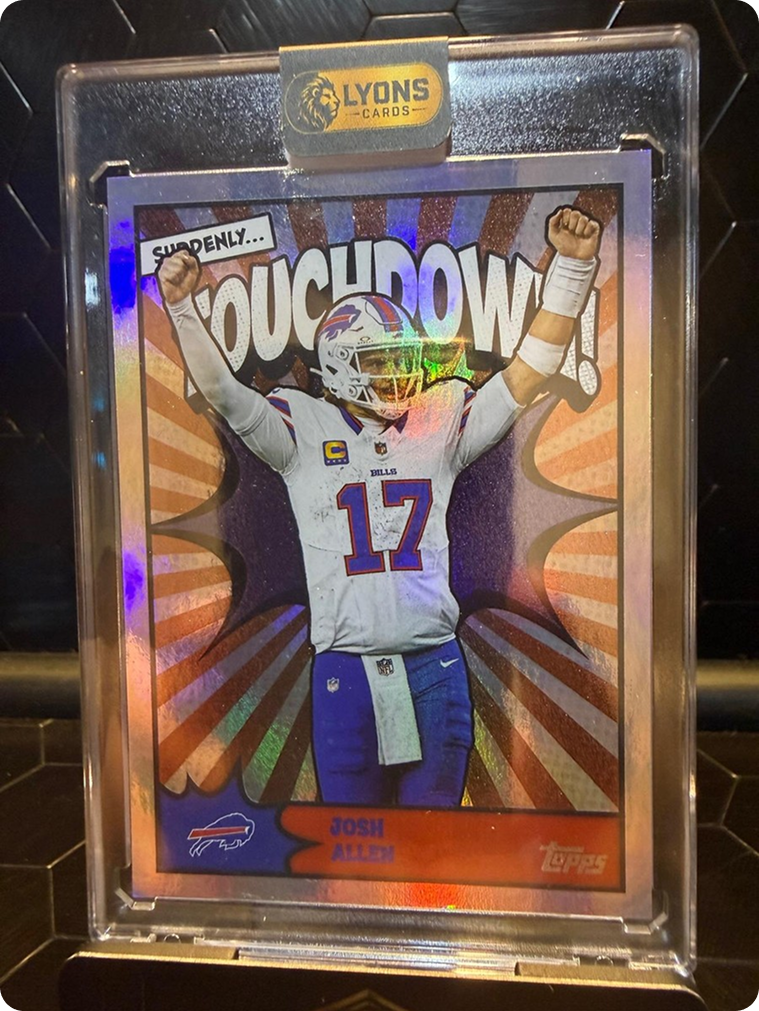
TOUCHDOWN
Josh Allen #TD-16
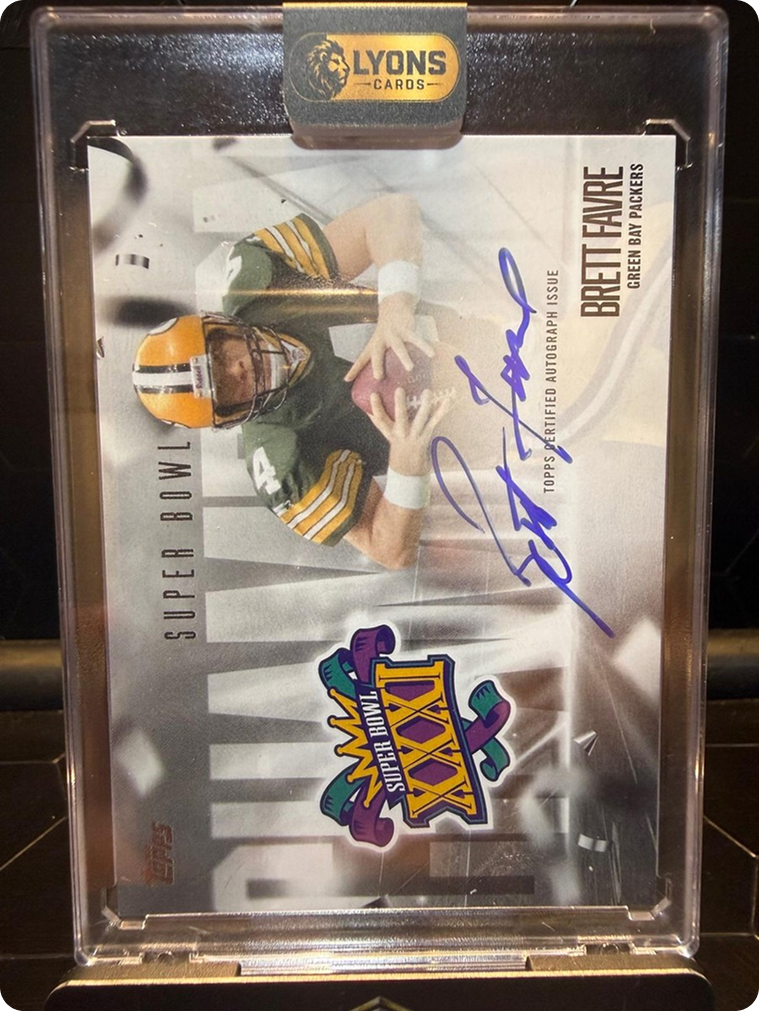
SUPER BOWL CHAMPION SIGNATURES
Brett Favre #SBCS-BF
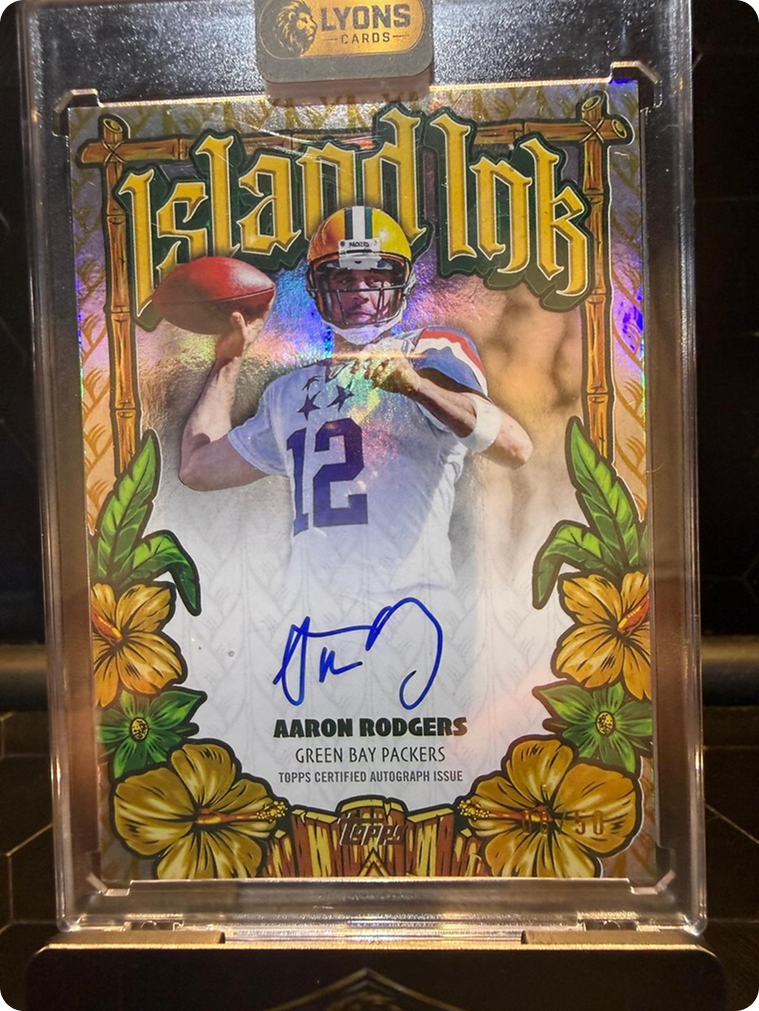
ISLAND INK
Aaron Rodgers #II-AR, on-card auto
Three of the collections above, shown with real cards from the Lyons Cards shop.
These are priorities, not a claim that they are the seven highest-priced card families. Establishing that ranking would require exact-card sold comparisons. The official checklist also includes Flagship First Signatures, dual signatures and memorabilia collections.
My practical approach is to pick one premium collection and one affordable project. Build the affordable project through sorting and trades. Buy specific missing premium singles when the price makes sense. A great-looking set should not become an excuse to keep opening boxes indefinitely.
Players to recognize without pricing every card the same
Topps highlights Fernando Mendoza, Jeremiyah Love and Carnell Tate among the rookies, with Josh Allen, Patrick Mahomes and Joe Burrow among established stars. Brady, Peyton Manning and Drew Brees add another collecting generation. Treat these as checklist research targets, not a current performance ranking or a promise of equal autograph availability. Topps release description.
A recognizable name is only the first step. The same player can appear on a common paper card, a scarce insert, a numbered parallel and an autograph. Those are separate markets. A star’s ordinary base card does not inherit the value of his rarest signature.
For our collection, I would prioritize cards where the player, design and identifiable scarcity work together. That might be a favorite veteran’s numbered insert instead of a rookie base card. It might also mean buying a moderately priced single that we enjoy rather than chasing the most expensive card in the product.
What the odds say about premium inserts
Touchdown illustrates why a box can contain inserts and still miss the premium card a collector had in mind. The published standard Touchdown row lists one in 603 Hobby packs and one in 151 Jumbo packs, with no regular retail entry. Topps odds sheet, hosted by Checklist Insider.
| Touchdown standard family | Pack odds | Packs per box | Long-run average spacing |
|---|---|---|---|
|
Hobby |
1:603 |
20 |
About 30.2 boxes per card |
|
Jumbo |
1:151 |
10 |
About 15.1 boxes per card |
The last column divides published pack odds by packs per box. It is an average spacing across production, not a countdown, a guarantee, or the odds for a particular player. It does not mean the next box is “due.” It also does not include other Touchdown parallels.
This is why I resist using “case hit” as a promise. The useful question is whether the actual format offers the card and what its published odds mean for the opening you are considering.
How to recognize a card worth researching
Read the card number and the full insert name first. Then inspect the image, border, finish and back. Put a suspected variation beside a confirmed base version. An unusual-looking card belongs in a research pile until its identity is established.
Some parallel limits illustrate the need for precision: the base Gold is numbered to 2,026, while Gold Rainbow Foil is numbered to 50. Jumbo Sandglitter has an unnumbered version and numbered versions. Color alone is not an identification system. Parallel reference.
For autographs, inspect whether the signature is on the card or a sticker and compare the exact autograph family. For memorabilia, read the back’s wording instead of assuming every swatch is game-used. Keep redemption codes covered. For grading, examine centering, corners, edges and surface; do not price a raw pull as though it already earned a PSA 10.
We are not publishing an unverified back-code shortcut here. Small print can help with identification, but a code borrowed from another sport or release can create a costly mistake.
The base-card problem
Here is my biggest criticism: Flagship’s volume can feel out of step with the experience a collector wants at a premium box price. If you collect the base set, that volume has a purpose. If you mainly want scarce inserts, much of the stack can become sorting work between the cards you actually came for.
That does not make base cards worthless to every collector. Team sets, binders, trades and family collecting are legitimate uses. It means we should not build a resale argument around the number of cards in the box.
Total base production is not established in this guide. Any large production estimate needs its assumptions, format coverage and calculation shown before it becomes a headline. A serial-numbered parallel has a defined limit for that version; an unnumbered card does not acquire a verified print run because we have seen it often—or rarely.
Prices change the verdict
Checklist Insider records Topps’ July 24 presale at $119.99 for Hobby and $269.99 for Jumbo, with Hobby moving to $129.99 on release day. Those are historical reference points, not available offers. The same source reports $24.99 Value and $49.99 Mega presale prices. Historical pricing source.
| Source checked October 27, 2026 | Hobby ask | Jumbo ask | Evidence status |
|---|---|---|---|
|
Steel City Collectibles |
Direct product-page asking prices | ||
|
Collector Store |
$199.95 |
$399.95 |
Aggregator-reported; direct price not independently confirmed |
|
RbiCru7 Collectibles |
$200.00 |
$390.00 |
Aggregator-reported; direct price not independently confirmed |
|
Dave & Adam’s |
Price not exposed in the retrieved pages; no quote assigned |
These are asking prices before tax and any shipping charges, not completed sales. Availability and checkout totals need confirmation. We did not establish a reliable recent sold-box sample or exact-card resale baseline for this article, so there is no claimed expected box return.
At Steel City’s displayed prices, Jumbo costs $195 more than Hobby. That buys the different advertised configuration and more cards. It does not establish that the extra cards or autograph are worth $195. The comparison that matters is what you could select as singles with that same additional money.
The Pricing King verdict
Flagship earns a place in the collection more easily than it earns an unlimited box budget. Its best feature is the breadth of collecting projects. We can enjoy football history, modern players, team sets and premium designs within one release. Its biggest weakness is that a higher sealed price does not improve the cards in an ordinary box.
For set builders, start with a checklist and a fixed spending limit. Retail may be a sensible way to enjoy more cards, but compare the delivered price and exact exclusives. For autograph-focused collectors, Hobby’s “or relic” wording matters; Jumbo provides the more direct advertised autograph route, while a single lets you choose the signer.
For premium-insert collectors like us, I favor targeted singles and selective openings. Touchdown and Super Bowl signatures are collections I want to pursue deliberately. They are not a reason to assume every sealed box is a good investment.
As an editorial opening budget, I would be more comfortable around $130–150 for Hobby or $270–300 for Jumbo before tax and shipping. Those ranges reflect my willingness to pay for the collecting experience near the historical launch level. They are not current offers, sold-market valuations or estimates of the cards coming back. At roughly $200 Hobby and $395 Jumbo asks, I would lean toward singles unless the entertainment and set-building experience itself justifies the expense.
My collector preference still puts Bowman Football ahead of Flagship, with Chrome also ahead of Flagship in my personal ordering. That is a preference for the collecting experience, not evidence that every Bowman or Chrome card will appreciate. Flagship can sit lower in that ranking and still contain individual cards I would rather own than another sealed box.
For breakers, explain the format, team assignments and shipping rules before bidding. For sealed holders, recognize that future demand, supply and entry cost remain uncertain. A returning brand is a story; future appreciation is still a thesis.
Watch the review and collect with us
Pair this guide with Tom Lyons’ Flagship Football video for the on-camera side of the discussion. Then tell us what you would build: a team set, a Touchdown collection, a Super Bowl autograph collection or a favorite player’s numbered cards.
Follow Lyons Cards on Whatnot at @LyonsCardsLive for our Flagship shows and Friday-night Bowman Football and Bowman Basketball breaks. Check each posted show for the actual lineup and assignment rules. Our planned Heritage break will be announced separately.
Research distinguishes official product descriptions, published odds, observed asking prices and Tom’s collecting preferences. This is a product guide, not a promise that opening a box recovers its purchase price. Linked sellers are comparison resources; no reciprocal links or endorsement arrangements are implied.


FROM MARKET INTELLIGENCE TO PORTFOLIO STRATEGY
YOUR CARDS ARE ASSETS. MANAGE THEM THAT WAY.
Revenue-management discipline applied to individual cards and collections, evaluating when to sell, hold, grade, take live, watch or pass.
SELL • HOLD • GRADE • LIVE • WATCH • PASS