

THE LYONS EDGE • ROADSHOW • ARIZONA • RIP VALLEY
THE HUNT FOR BOOKER
AT RIP VALLEY
Scarcity and access are different questions.

Before walking into RIP Valley in downtown Phoenix, I recorded what brought me there: I had heard about Jordan’s Devin Booker collection, and I wanted to see it for myself. Booker was the target. The bigger question was how a card moves from something a collector admires to something a buyer can actually acquire.
In the introduction, I described liquidity velocity in practical terms: when buyers show up, how quickly can the cards move? Inside the shop, that question opened into a conversation about collecting, availability, and the limits of a price on a screen.
A shop with a place in the neighborhood
RIP Valley is at 214 E Roosevelt Street, Suite 1, in Phoenix’s Roosevelt Row arts district. The shop is inside the monOrchid building, with a card counter and dedicated space for streaming. General manager Jordan Moss and retail store manager Neil Thomasson are part of the team behind it.
The footage gives the visit its setting: the exterior, the shop floor, the clothing and shoes, and the people across the counter. That matters to a roadshow. I want viewers to understand where we went and who we met, as well as what was inside the cases.
Jordan tells me he has been with the shop for a little over a year. He explains that the owners wanted to build a community around a hobby they loved, and that the business had recently moved a short distance to expand. Later, when I ask about his pride in the store, he returns to the community it serves.
The interview runs a little over nine minutes. Keeping the conversation with the article lets readers hear the collectors themselves. A short clip can show a card. A longer conversation can explain why somebody owns it and whether they would ever let it go.
Why Booker moves differently in Phoenix
When I ask how quickly buyers absorb Booker cards, the team’s answer is rooted in the local collector base. Booker is a personal-collection player for many Phoenix customers. That attachment can make people want a card even when the broader hobby is talking about somebody newer.
This is an observation from people working the counter, not a measured sell-through rate. It is also why I would not assume that a large local supply automatically produces cheap cards. Phoenix has Booker inventory, but it also has Booker collectors. We need to understand the buyers as well as the sellers.
We talk about the attention that moves toward the next young star, including Cooper Flagg and Victor Wembanyama, while an established player can slip out of the hobby’s daily conversation. The team offers its view that Booker remains a compelling player to collect. That is a collecting opinion, not a promise that every Booker card is underpriced.
I also ask about the different stages of his market: the Finals period, the excitement around Kevin Durant’s arrival, and the changes that followed. Those are prompts for discussing demand. To put a percentage increase or decrease on any of those periods, I would still want a dated sales history for the specific card.
The Booker card that makes you stop
During the interview, a Devin Booker Flawless Logoman is held up close to the camera. It is the kind of piece that makes a hunt memorable even before anyone talks about a transaction.
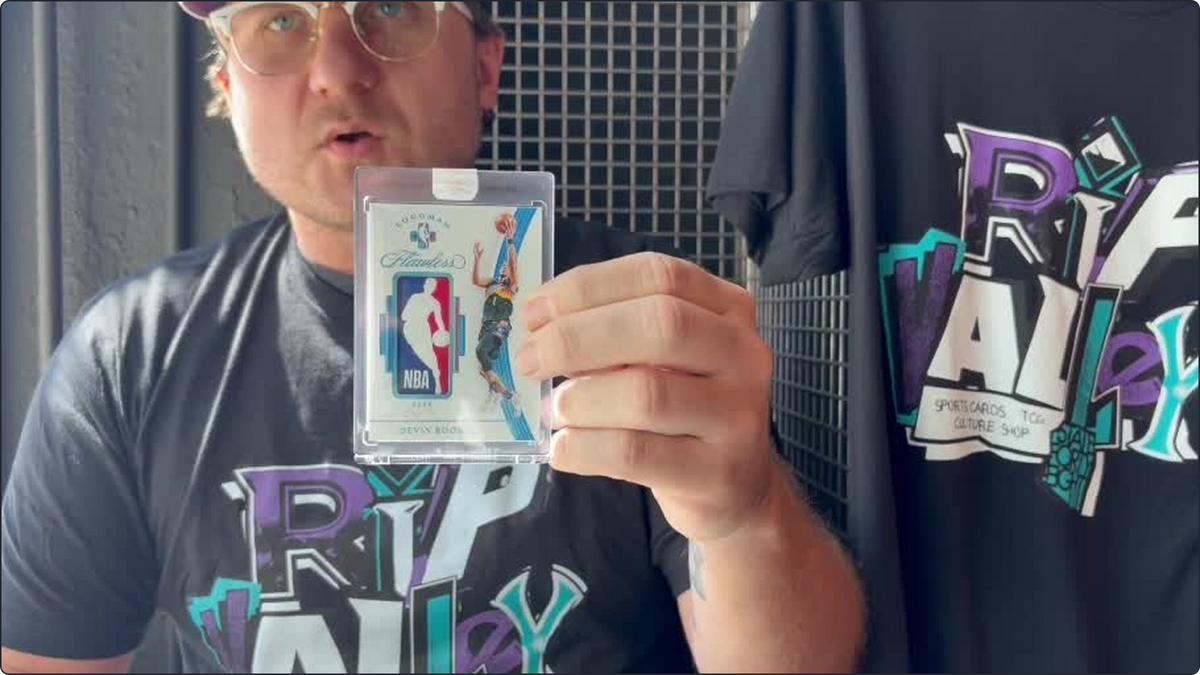
The Booker Flawless Logoman shown in the original RIP Valley interview. The image is a frame from the footage.
Two premium Booker cards come out during the interview, described as a card numbered to five and a one-of-one Logoman. The conversation includes an estimate around $9,000 for one card and a much broader possible range of $20,000 to $40,000 for the other. The speakers also acknowledge the lack of a direct sale for the unique card. Those are estimates discussed during the visit, not transactions we completed or current appraisals.
Our separate visit recap describes a Booker one-of-one that was not for sale. That is an important collecting lesson in its own right. A card can exist, be known to collectors, and still be unavailable to the market.
If the owner is keeping it, a buyer cannot solve the problem merely by locating the card. There has to be willingness on both sides. A personal collection does not automatically become sale inventory because another collector wants a piece of it.
That is why I separate the number of cards produced from the number I can buy. A print run describes an edition. Available supply describes the copies owners are actually offering at a given time. Those quantities can be very different.
Scarcity and access are different questions
At Lyons Cards, we look closely at National Treasures, Flawless, distinctive autographs, and low-numbered cards. Those products can give us clearly defined editions and features that collectors seek out.
But a numbered edition does not establish an ironclad price floor. A one-of-one can be difficult to price because there is no identical second copy trading beside it. There may be other cards of the same player competing for the same collector’s money, and the pool of buyers willing to pay a premium can be small.
A population report answers another question: how many cards have received a particular grade from that grading company. It is not a complete count of all surviving copies, all raw cards, or all copies available for purchase. I want those measures kept separate when evaluating a card.
The Booker hunt makes that practical. The interesting questions are what makes a particular card desirable, whether it is available, what alternatives buyers have, and how committed its owner is to keeping it. Looking only at a serial number leaves too much of the story out.
How do you price a card with no identical comp
I put that question directly to the team: if this is a one-of-one, where do you start?
The answer is a comparison process. Look for a related sale from another year, another product, or a comparable player. Then return to the exact year and set and think about how Booker’s market compares with the alternative. Each comparison needs an explanation; a similar-looking card does not automatically carry the same value.
I add the supply question: what else can a collector buy right now? If the cards a collector wants are locked away, the search may move to another issue or player. That can create opportunities, but the substitution is something to observe. We cannot assume demand transfers dollar for dollar from Jordan, Kobe, or LeBron to another player.
This is where I use the idea of inaccessible true collector cards. A treasured piece can be effectively outside the market because its owner has no interest in selling. Its existence does not give the next buyer access to it.
What I mean by a liquidity window
A liquidity window is a period when buyer attention and available inventory create a more favorable opportunity to transact. A performance, a playoff run, or renewed attention to a player can change that balance. It still takes an actual buyer at an acceptable price to complete the sale.
Liquidity velocity brings time into the decision. A card with frequent matching sales gives me different information from one with a high asking price and no recent transactions. I want to understand the number of buyers relative to the cards offered, how often sales occur, and whether sellers are having to lower prices to complete them.
That is why a market chart is a starting point for a conversation. If the chart follows a common base card, it may tell us little about a scarce memorabilia card or a one-of-one. If it follows a thinly traded premium card, a single sale may make the picture look more settled than it is.
The goal is to judge the exact card and the time horizon. What might sell within 30 days? What could require a longer period and a carefully chosen channel? What would I hold because I believe in the collecting appeal, while accepting that the next buyer may take time to arrive?
The cards in our pickup recap
The RIP Valley pickup graphic records three additions for Connor: a Steve Young autograph, a Bucky Irving National Treasures rookie patch autograph, and an Omarion Hampton Flawless autograph. It lists a combined asking total of $560 and our price as $320.
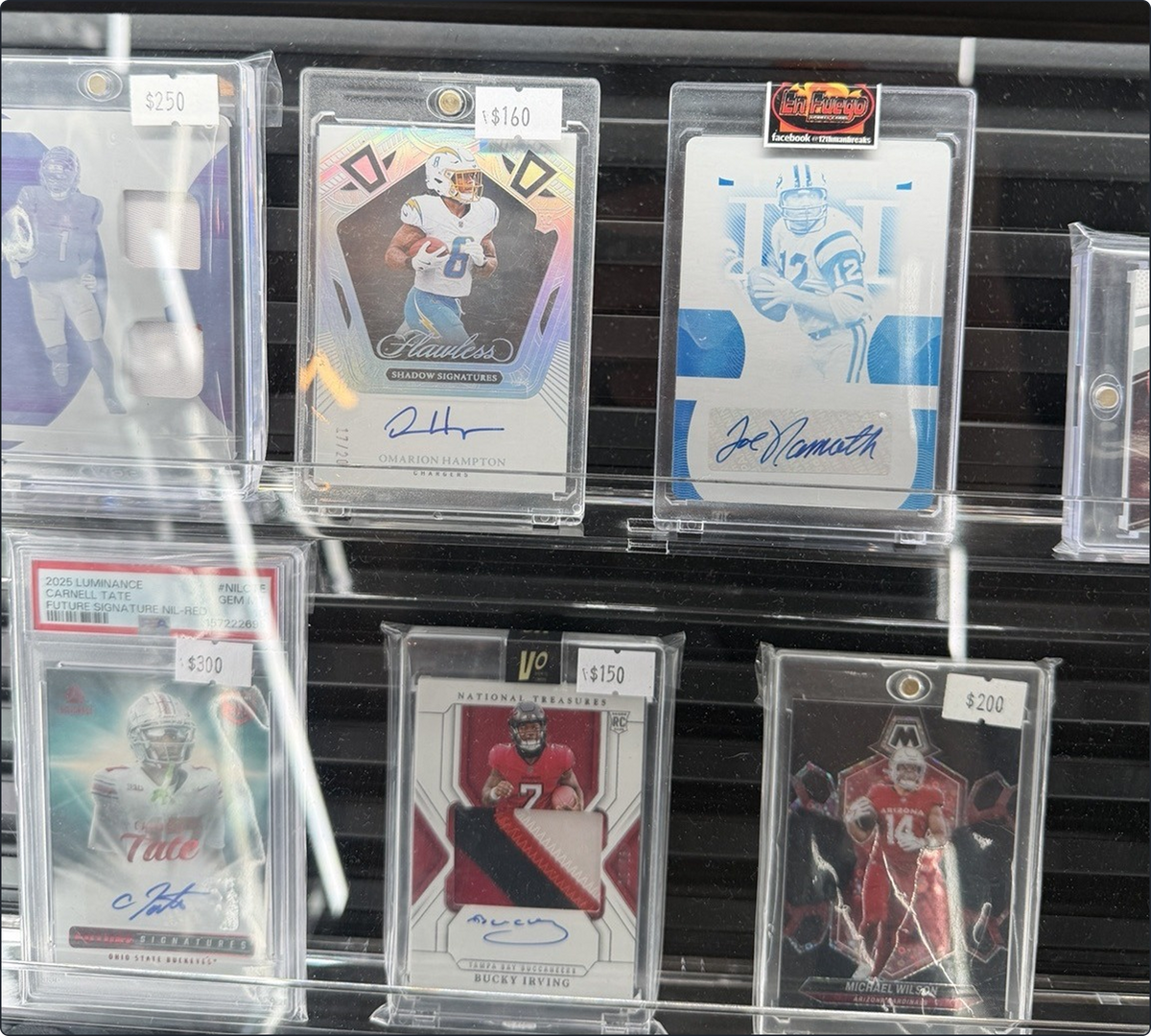
Part of the RIP Valley display case, with the Omarion Hampton Flawless and Bucky Irving National Treasures autographs among other cards. The stickers are asking prices.
That is a $240 difference, or about 42.9 percent below the combined asking prices. It is a discount from the sellers’ asks, not a 42.9 percent investment return. To calculate an actual return, we would need the eventual net sale proceeds and the costs of selling.
THE PICKUP RECAP AT A GLANCE
From the pickup graphic. The $240 is a discount from the asks, not a return. It is separate from the $1,320 card-show haul.
The selection also shows why the hunt does not have to end with the player in the headline. An established name and younger players can offer different kinds of collecting appeal. Each card still needs its own evaluation. Buying three cards together does not make their demand, risk, or time to sell identical.
The $320 recap belongs to RIP Valley. Our $1,320 trade-show haul belongs to the separate Northwest Valley show article. Keeping the visits and their transactions distinct is part of keeping useful buying records.
What comes home from a visit
A roadshow can produce a purchase, a new relationship, a better understanding of a market, or the chance to see a card that rarely leaves someone’s collection. Those are different outcomes, and each can make the visit worthwhile.
For me, the Booker hunt connects the collector’s attachment to the pricing work. A card’s owner may value keeping it more than the cash another person is prepared to offer. Elsewhere in the same shop, an available card may fit our budget and our buying plan. Both situations belong in the story.
That is what I want people to see in the video: a real shop, real collectors, and a discussion that goes beyond the latest comp. We came to hunt Booker. We also came to understand how scarcity, access, demand, and time interact when there is an actual card across the counter.
At the end, Jordan encourages visitors to explore other shops around the Valley as well. It is consistent with the community emphasis that opened the interview: help people learn the hobby and find what they collect.
The hunt continues.


FROM MARKET INTELLIGENCE TO PORTFOLIO STRATEGY
YOUR CARDS ARE ASSETS. MANAGE THEM THAT WAY.
Revenue-management discipline applied to individual cards and collections, evaluating when to sell, hold, grade, take live, watch or pass.
SELL • HOLD • GRADE • LIVE • WATCH • PASS